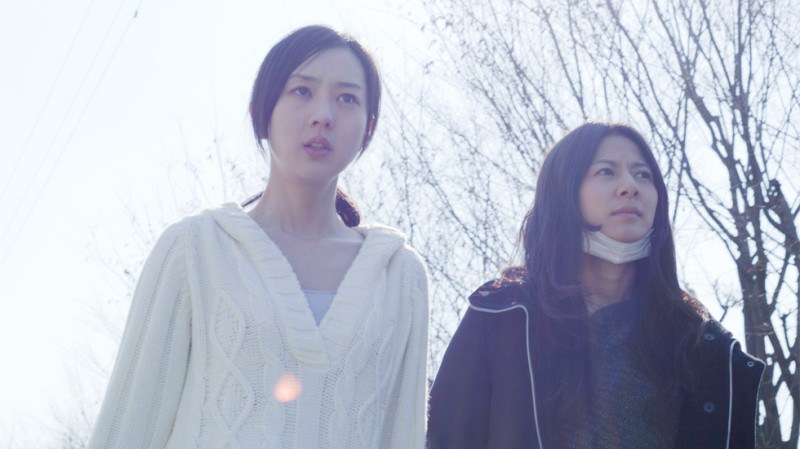
Director: Nobuteru Uchida
Starring: Kiki Sugino, Yûki Shinohara, Takeshi Yamamoto
Run Time: 102 mins
Tribeca Program: Viewpoints
Unlike many films about the March 11, 2011 Disaster in Japan, Odayaka is not set in Fukushima or Iwate prefectures, or in the northwestern region of Japan known infamously as “Tohoku” to the rest of the world. It does not even have a single shot of the ocean. Odakaya is set in the Tokyo suburbs, where things appear to be peaceful, but a darkness lies beneath. The story revolves around two women. Saeko, played by Kiki Sugino, is a mother in her twenties. Yukako, played by Yukiko Shinohara, is in her thirties, and has no child due to a miscarriage. Both women struggle to understand the post-disaster environmental situation and the pending health risks to the children in town. Everything else is calm, which makes great contrast with the two women, who are restless throughout the film. Through the women, director Uchida delivers his message to Japan: It is okay to be afraid.

Odayaka is told in a soap-opera style, where medium shots and close-ups of characters dominate each scene. Most of the scenes are also inside the home. The characters talk a lot, but most of their dialogues end in disagreement, often suspended by a mutual, “hmm” or “huh…” They do this because of the complexity of the issues they face, and the difficulty of explaining the backstory to their listener. Saeko, for example, finds out her husband is cheating on her, and then faces discrimination from her child’s kindergarten for forcing her child to wear a mask, to prevent breathing in invisible radioactive particles. With each passing scene, more words are needed to fully explain her actions, making it more difficult for her to say anything; the viewers feel the inadequacy of language. Saeko breaks down in tears at multiple places in the film. Each time, she does it differently, but the effects on the audience are equally powerful.
The film is political because it condenses many cliché Japanese characters who appear after the 3-11 Disaster: The company chief who refuses to let his workers take a job transfer, the school teacher who explains to parents that the cafeteria food is safe to eat, the wife of a nuclear plant worker who refuses to acknowledge anything is wrong… Each character offers a slice of hopelessness that the viewers must take in, and come to the conclusion that Japan is institutionally ill with no simple solution. The film grounds this idea with a serious first scene, when the earthquake strikes, and the characters shake in fear.

But the film is not political, especially in translation. Nobody in America would recognize the “ring ring, ring ring,” warning sounds in the television as the national Earthquake warning sounds. To the average Japanese, hearing that sound on TV instills fear in their hearts. No one outside of Japan would have known that the repetition of the message, “Everything is fine, no need to worry” in the film is actually the norm in Japan post-disaster — We would have thought it to be annoying. It is true that the film seems to have low expectations in its audience, and illustrates each idea with one too many examples, but like director Uchida said in the Q & A session (Coming Soon), it is a film that creates dialogues among strangers. The conflict between the doubters and believers of the nuclear scare, for one, should have long been recognized. These slightly heavy-handed scenes about the mundane are what make Odayaka an important film.
Photo credit: Aya Saito