Director: Edward Zwick
Actors: Tobey Maguire, Peter Sarsgaard, Liev Schreiber, Michael Stuhlbarg
Writer: Steven Knight
Country: USA
Rating: PG
Runtime: 114 min
During the 1970s, everybody knew the name Bobby Fischer. This young chess genius made headlines for both his incredible game as well as what was considered to be a rather eccentric personality. Edward Zwick’s docudrama Pawn Sacrifice (2013) does more than simply chronicle the life of this individual and does not make attempts to create a sympathetic or particularly likeable character. Instead, it presents its protagonist as true to life as possible, and demands that an audience take responsibility for his ultimate downfall.
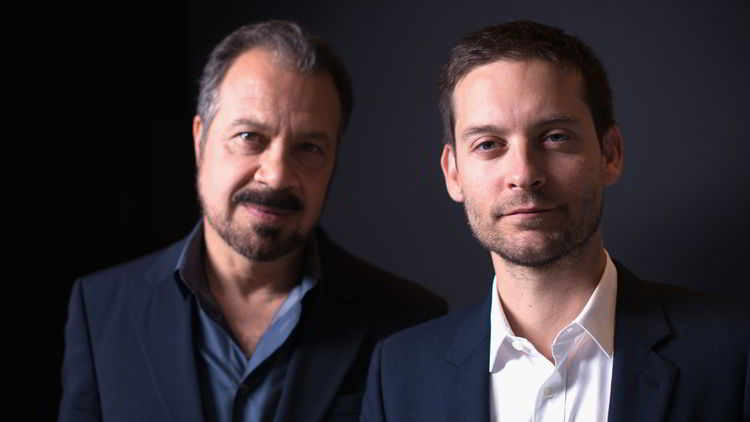 Director Edward Zwick and Tobey Maguire
“The Match of the Century,” as it was known, pitted American chess master Bobby Fischer (Tobey Maguire) against Russian phenomenon Boris Spassky (Liev Schreiber) and drew more audience attention than any chess game before it. This match came to represent far more than a chess game, as Cold War tension and political ideals inevitably came into play. Although Boris was considered to be unbeatable, Bobby believed himself to be more than up to the challenge. This film focuses not only on the tournament, but also on the demise of Bobby’s sanity as well. Taught paranoia at an early age, Bobby suffered from terrifying delusions that affected his public persona and earned him his reputation as an antisocial and demanding eccentric.
As the iconic Bobby, Maguire presents an accurate representation as opposed to softening his performance or making an attempt to render his character empathetic. Bobby is not likeable, but it is easy to pity him as we watch his brilliant mind turn him against reality and cause him to fear Russian spies at every turn. Peter Sarsgaard delivers a standout performance in the role of a chess-playing priest who becomes Bobby’s mentor. Although this individual appears to have Bobby’s best interests at heart, one cannot help but wonder why more was not done to help and protect Bobby when he was clearly in no mental state to continue in the public eye.
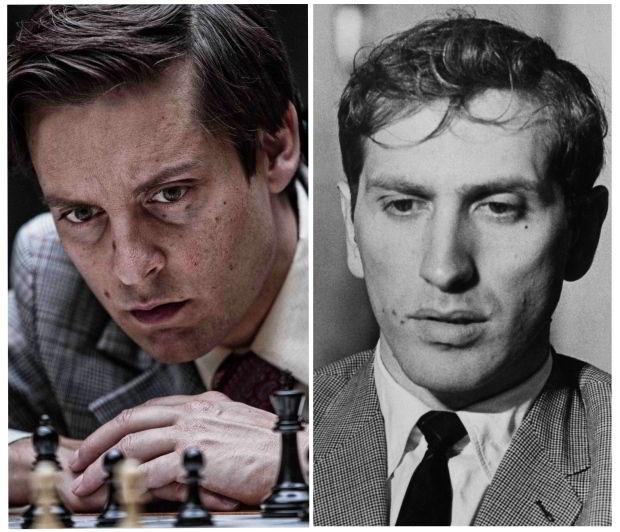 Tobey Maguire playing Bobby Fischer in Pawn Sacrifice. Bobby Fischer seen on right.
The idea that a game such as chess could attract widespread interest to such an extent is fascinating, especially when one considers the political implications of the match, and Zwick effectively turns this event into an interesting story.Some of the film footage has been shot to appear as though it is real video footage of the historical event, adding a feeling of legitimacy to the work and putting the “documentary” into “docudrama.” The director also shows a bit of Bobby’s backstory, which may be speculation but helps us to understand this individual and get inside of his head – as much as one can understand a mind as brilliant yet as maddened as this one. Although an audience knows that all of the threats that assail Bobby are imagined, the film nonetheless maintains a tense atmosphere through Zwick’s hectic filming, intense music, and dark lighting. The film ends up becoming a bit tedious by its drawn out conclusion, yet I suppose this fault may actually be representative of the nature of the game of chess itself.
Pawn Sacrifice is a well-made biopic that will appeal to those who are interested in the Bobby Fischer story or in the world of chess. An unlikeable protagonist and a story of which we already know the conclusion may prevent mainstream appeal, but the film asks questions that many should consider. While watching the work, I could not help but wonder who was looking out for this young man with clear mental challenges. The public knew of Bobby’s odd demands and eccentric outbursts, yet little appears to have been done to provide him with aid or to take responsibility for him. A sad story overall, Pawn Sacrifice does not offer an uplifting experience, but it does offer a peek at the truth.