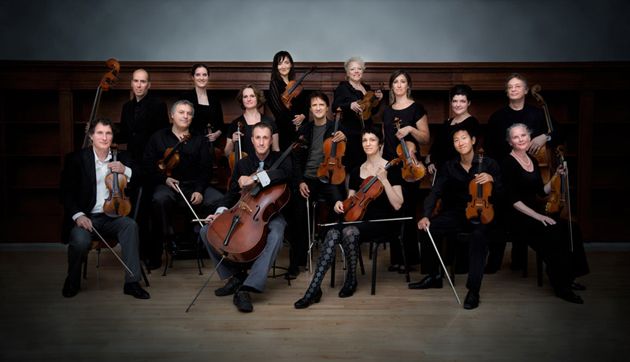
Highlighting talented musicians from all over Canada is one of our goals here at The Arts Scene, and when the Orchestre de Chambre I Musici de Montréal traveled to my hometown of Brockville, I was given the opportunity to do just that. This incredible group, featuring fifteen individuals of varying ages commanding beautiful string instruments of varying sizes, was formed in 1983 by cellist Yuli Turovsky and is now under the artistic direction of Jean-Marie Zeitouni. Although young, the current conductor-in-residence, Montreal Conservatory graduate Jean-Michel Malouf, is known for his highly expressive and compelling conducting techniques, drawing forth passionate music from his orchestra. Not only does the group feature renowned musicians from this country and abroad, but it also places a spotlight on emerging Canadian musicians, something we appreciate and consider to be of the highest value.

The Orchestre claims that their chief mission is to “promote and contribute to the knowledge, development, composition, and execution of music,” and watching them perform, there can be no doubt that they are accomplishing just that goal. The evening began with Wolfgang Amadeus Mozart’s familiar serenade “Eine Kleine Nachtmusik (A Little Night Music).” Although the piece is very recognizable, one could nonetheless find new aspects to enjoy; this piece that is heard so often in recordings truly takes on new life when enjoyed live. The work is delicate, yet full of bright life and energy, and this mood was captured perfectly as the bows of the musicians flew over their strings at a dizzying rate.
Next, the orchestra moved on to Felix Mendelssohn’s symphony entitled “Lobgesange (Song of Praise),” which he wrote at the age of twelve. It is here in the andante movement that we are first exposed to the mournful and plaintive sounds of which a string orchestra is capable, and one cannot help but wonder how a mere child was able to create such a mood and mimic these emotions. The Orchestre sounded full-bodied and enthusiastic as it tackled a piece that was simultaneously simple and complex, concluding with a lively finale.

Rounding off the first half of the concert was a piece very unlike the previous two: Benjamin Britten’s decidedly more contemporary “Simple Symphony,” in which he reworked four short piano pieces that he wrote between the ages of nine and twelve into an entire four-movement symphony. This piece highlights many musical aspects that are unique to the string instrument family, such as the sounds produced when the strings are plucked or strummed in the humourous pizzicato movement, and gave the orchestra a chance to have fun and show off their lighter side. These unique movements with differing styles are very unlike those which a string orchestra audience may have come to expect, but are unfailingly pleasant, offering a refreshing change of pace.
Finally, the evening concluded with Antonin Dvorak’s “American” string quartet, arranged for the string orchestra by the group’s conductor Malouf himself. This work is based on the bluesy sounds of American folk music, and these motifs appeared frequently throughout the piece. This is the music of an epic movie soundtrack, and the Orchestre perfectly captured the varying moods and emotions that nevertheless remained, in characteristic Dvorak style, exceedingly grand. The orchestra concluded on an uplifting and triumphant note, a wonderful end to a fantastic program.

Watching the animated Malouf conduct was a real treat, as he appeared to visibly feel each emotion before coaxing it from his musicians. His youthful, chatty, and down-to-earth demeanor could not hide his immense talent, as he led the performers without ever overpowering them or taking away from their individuality. After the scheduled performance, the Orchestre indulged the audience with a question and answer session led by Malouf himself. This period revealed a laid-back, almost familial relationship within the group. It was interesting to learn that the Orchestre retains two original members, as well as attracting many younger musicians. Also, one was reminded of the way in which the musicians frequently switched positions between pieces, and it was revealed that these changes were done in order to allow each member a chance to shine and play a featured part; this attitude was one aspect of the group that I appreciated and found noteworthy.
An orchestra composed entirely of string instruments is something especially compelling. Without loud brass and wind instruments to create dynamics, each sound produced by these strings is afforded attention. Watching the Orchestre de Chambre I Musici de Montréal, one did not see fifteen individuals, but a collective, co-operative whole. The ways in which these instruments, led by a fiery young conductor, interact to create music reveal a stunning passion in individuals who clearly love what they do. The result truly is a celebration of music.

Photo Credits: Orchestre de chambre I Musici de Montréal – photos from other past performances.